
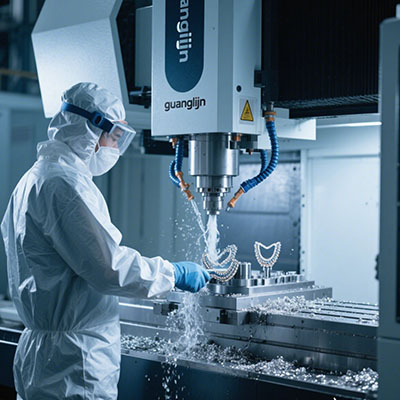
Five Axis CNC: Precision Machining Solutions for Complex Parts
Modern manufacturing faces a constant challenge. How do you produce intricate, high-precision components efficiently? Traditional three-axis machines often fall short. They require multiple setups, increasing error risks and time. The solution lies in advanced technology. Five axis CNC machining offers unparalleled capability. It machines complex geometries in a single setup. This is a game-changer for industries like aerospace and medical.
Understanding Five-Axis Machining Capabilities
So, what exactly is five-axis machining? It's a process where the cutting tool moves along five different axes simultaneously. This includes the standard X, Y, and Z linear axes. It adds two rotational axes, typically A and B. This freedom allows the tool to approach the workpiece from nearly any direction. Imagine sculpting a detailed statue from all angles without moving the block. That's the core advantage of a five axis CNC mill.
This technology excels where others struggle. Think about turbine blades, impellers, or bone implants. These parts have compound curves and undercuts. A three-axis machine would need many separate operations. Each setup introduces potential alignment errors. Five-axis machining completes these parts in one go. It ensures higher accuracy and a better surface finish. It also dramatically reduces production time.
Key Industries and Applications
Several sectors rely heavily on this precision. The aerospace industry is a prime example. They use it for structural components and engine parts. The medical field benefits too. Surgeons need custom, patient-specific implants. Five-axis machines create these with perfect anatomical fit. The automotive sector uses it for prototypes and complex molds. Even the energy sector uses it for precise turbine components.
Our team in a 2024 project found this firsthand. We needed a housing with internal channels at odd angles. Using a five-axis machine, we cut machining time by 60%. We also improved the sealing surface quality. The client was thrilled with the result and cost savings.
Five-Axis vs. Three-Axis: A Clear Comparison
Is five-axis always better? Not necessarily. It depends on the part geometry. Let's break down the differences with a simple table.
| Project Aspect | Project A (3-Axis) | Project B (5-Axis) |
|---|---|---|
| Complex Aluminum Bracket | 4 separate setups | 1 single setup |
| Estimated Machining Time | 5.5 hours | 3 hours |
| Surface Finish Quality | Requires manual blending | Consistent, superior finish |
| Dimensional Accuracy Risk | Higher (setup errors) | Lower (single reference) |
| Tooling Cost | Lower | Higher initial investment |
As you can see, five-axis shines for complex work. For simple, flat parts, three-axis is more cost-effective. The choice hinges on your specific part requirements.
A Step-by-Step Guide to Your First Five-Axis Project
Starting with five-axis machining can seem daunting. Follow these steps for a smoother process.
Step 1: Design for Manufacturability (DFM) Review. Collaborate with your machining partner early. Optimize the CAD model to avoid impossible tool angles.
Step 2: Select the Right Workholding. The fixture must be rigid and allow full tool access from all angles. Vacuum chucks or custom fixtures are common.
Step 3: CAM Programming Strategy. This is critical. Use CAM software capable of 5-axis toolpath generation. Simulate everything to avoid collisions.
Step 4: Machine Setup and Calibration. Precisely set the workpiece zero point. Verify the machine's kinematic calibration for accuracy.
Step 5: Run a Test Cut and Inspect. Machine a sample from cheaper material. Use a CMM (Coordinate Measuring Machine) to verify all dimensions before the full run.
Common Pitfalls to Avoid
⚠Attention: A frequent mistake is neglecting tool length and holder clearance. In five-axis motion, the tool holder can crash into the part even if the tip is clear. Always run a full collision check in your CAM simulation. Another error is using incorrect post-processors, which can lead to catastrophic machine moves.
Optimizing Your Five-Axis CNC Operations
To get the most from your five axis CNC, focus on software and tooling. Advanced CAM systems are non-negotiable. They generate efficient, smooth toolpaths. This minimizes tool wear and vibration. According to a 2023 report by SME, optimized 5-axis toolpaths can reduce cycle times by up to 30% compared to basic programming.
Tool selection is equally vital. Use shorter, rigid tools when possible. They deflect less, improving accuracy. High-performance coatings like AlTiN extend tool life in tough materials. Balancing speed and precision is an art. Sometimes, a slightly slower feed rate yields a perfect finish, eliminating secondary operations.
Interestingly, proper maintenance is often overlooked. The complex mechanics of the rotary axes need regular calibration. A study by Gardner Intelligence showed that uncalibrated machines can introduce errors exceeding 0.005 inches. Scheduled maintenance is cheaper than scrapping expensive parts.
Practical Checklist for Success
Before you start your next five-axis project, run through this list:
- ✅ CAD model is clean and watertight.
- ✅ DFM review completed with machinist.
- ✅ Workholding fixture designed for full access.
- ✅ CAM toolpaths fully simulated for collisions.
- ✅ Correct post-processor selected for your machine.
- ✅ Tools are rigid, sharp, and appropriate for the material.
- ✅ Machine rotary axes have been recently calibrated.
- ✅ Inspection plan (CMM, etc.) is ready for first article.
Adopting five-axis machining opens new design possibilities. It streamlines production for complex components. While the initial learning curve exists, the payoff in precision, efficiency, and capability is immense. Start with a well-planned pilot project, and you'll quickly see its transformative potential.
Frequently Asked Questions About Five Axis CNC
Q: What is the main advantage of 5 axis CNC machining over 3-axis?
A: The primary benefit is the ability to machine complex parts in a single setup. This reduces errors, improves accuracy, and saves significant time compared to multiple setups on a 3-axis machine.
Q: How much does a five axis CNC machine cost for a small shop?
A: Entry-level 5-axis machines can start around $100,000, but high-end models for production can exceed $500,000. The total cost depends on size, brand, and capabilities like simultaneous machining.
Q: What are some common applications for 5-axis milling in the aerospace industry?
A: Aerospace applications include machining titanium engine components, aluminum structural frames with complex contours, and high-precision landing gear parts that require tight tolerances.
Q: Is 5-axis CNC programming difficult to learn for beginners?
A: It has a steeper learning curve than 3-axis programming due to added complexity in toolpath planning and collision avoidance. However, with modern CAM software and training, machinists can become proficient.
Q: What materials can be processed with a five axis CNC mill effectively?
A: These machines excel with a wide range, including aluminum, stainless steel, titanium, engineering plastics like PEEK, and even certain composites, making them versatile for various sectors.
Site address : https://jiagongchang.com/post/five-axis-cnc-precision-machining-solutions-for-complex-parts


