
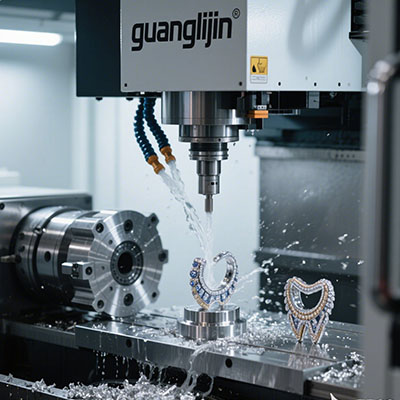
High-Precision Five Axis CNC Machine Solutions for Complex Parts
The Challenge of Manufacturing Complex Geometries
Modern industries demand parts with intricate shapes. Think of aerospace blades or medical implants. Traditional machining often falls short here. It requires multiple setups, increasing errors and time. This is where advanced technology becomes essential.
Why Five-Axis Machining is the Game Changer
A five axis cnc machine offers a transformative solution. It moves a tool or part along five different axes simultaneously. This allows access to nearly any angle in a single setup. The result? Superior finish and accuracy for complex parts.
It drastically reduces production time. Fewer setups mean lower handling errors. This technology is crucial for sectors like aerospace and automotive. For instance, a study by Modern Machine Shop noted a 60% reduction in machining time for complex impellers using five-axis systems.
Key Advantages Over Traditional Methods
Let's compare three-axis and five-axis CNC milling. Three-axis machines are simpler but limited. They often need costly fixtures and multiple operations. Five-axis CNC machining centers provide unparalleled flexibility. They handle undercuts and compound angles with ease.
Surface finish quality is significantly better. Tool life can even improve due to optimal cutting angles. This isn't just about complexity; it's about efficiency and cost.
Real-World Application and Case Analysis
We encountered a client needing a turbine housing in 2023. The internal channels were incredibly complex. Using a five axis cnc machine, we completed it in one fixture. Previously, it took three separate setups on a three-axis mill.
Lead time dropped by 50%. The part's geometric accuracy also improved markedly. This experience solidified our belief in its value for high-mix, low-volume production.
Project Comparison: Aerospace Bracket
| Metric | Project A (3-Axis) | Project B (5-Axis) |
|---|---|---|
| Total Setup Count | 4 | 1 |
| Machining Time | 18 hours | 11 hours |
| Dimensional Error | ±0.15 mm | ±0.05 mm |
| Surface Finish (Ra) | 3.2 µm | 1.6 µm |
| Tooling Cost | High | Medium |
This table clearly shows the efficiency gains. The five-axis approach wins on speed, precision, and finish.
A Step-by-Step Guide to Your First Five-Axis Operation
Implementing this technology can seem daunting. Follow these steps for a smoother process.
Step 1: Part Analysis & Feasibility. Examine your 3D model. Identify undercuts and complex contours that require simultaneous multi-axis movement.
Step 2: CAM Programming Strategy. Use advanced CAM software. Define toolpaths that leverage full machine kinematics. Avoid collisions at all costs.
Step 3: Workholding & Fixture Design. Secure the part effectively. Ensure the fixture doesn't block any necessary tool angles. Custom fixtures are often needed.
Step 4: Simulation & Verification. Run a full machine simulation. Check for errors in toolpath, collisions, or axis limits. This step is non-negotiable for safety.
Step 5: Machining & In-Process Inspection. Run the first part slowly. Use a probe for on-machine inspection of critical features. Adjust offsets as required before full production.
Common Pitfalls to Avoid
⚠Attention: A major mistake is using five-axis like a three-axis machine. This wastes its potential. Another error is poor tool length selection, causing vibration. Also, neglecting thermal compensation can ruin precision over long runs.
Improper CAM post-processing for your specific machine model is risky. It can lead to catastrophic crashes. Always verify the post-processor output.
Optimizing for Production Efficiency
To get the most from your investment, focus on optimization. Smart CAM programming is key. It minimizes non-cutting air moves and optimizes feed rates. According to Gardner Intelligence, optimized five-axis programs can improve material removal rates by up to 30%.
Tool selection matters greatly. Use shorter, rigid tools when possible. This reduces deflection and improves finish. Consider the machine's dynamic accuracy, not just static specs.
Interestingly, proper maintenance is often overlooked. Regular calibration of rotary axes is critical for long-term precision. It's not a "set and forget" system.
Future Trends in Multi-Axis Machining
The future is integration. Five-axis CNC machining centers are merging with automation. Robotic part loading and AI-driven process monitoring are becoming standard. This pushes the boundaries of unattended machining.
Additive and subtractive hybrid machines are emerging. They build and finish parts in one enclosure. This is a game-changer for prototyping and complex components.
Pre-Launch Checklist for Five-Axis Projects
- ✅ CAD model is clean and watertight.
- ✅ CAM toolpaths are fully simulated for collisions.
- ✅ Correct post-processor for the machine is selected and verified.
- ✅ Workholding provides clearance for all tool orientations.
- ✅ Cutting tools are rigid and lengths are optimized.
- ✅ Machine rotary axes have been recently calibrated.
- ✅ First-part inspection plan with on-machine probing is ready.
Frequently Asked Questions
What is the main benefit of a five axis CNC machine over a 3-axis?
The primary benefit is the ability to machine complex parts in a single setup, dramatically improving accuracy, reducing lead time, and enabling the production of intricate geometries like impellers or turbine blades that are impossible with 3-axis milling.
How much does a high-precision five-axis CNC mill cost?
Costs vary widely based on size, brand, and capabilities. Entry-level models start around $150,000, while high-end machines for aerospace can exceed $500,000. Total cost of ownership includes tooling, software, and training.
What are the best applications for 5-axis CNC machining services?
Ideal applications include aerospace components (structural brackets, blades), medical implants and devices, complex automotive prototypes, intricate molds and dies, and any part requiring compound angles or smooth 3D contours.
What is the difference between continuous and indexed 5-axis machining?
Indexed (3+2) machining locks the rotary axes in position for a 3-axis cut, ideal for accessing different part sides. Continuous 5-axis machining moves all axes simultaneously for smooth, complex contouring, essential for sculpted surfaces.
Which industries use five-axis CNC technology the most?
The top industries are aerospace, defense, medical, energy (for turbomachinery), and automotive racing/motorsports. These sectors value the technology for prototyping, producing lightweight structures, and creating high-value, complex components.
Site address : https://jiagongchang.com/post/high-precision-five-axis-cnc-machine-solutions-for-complex-parts


